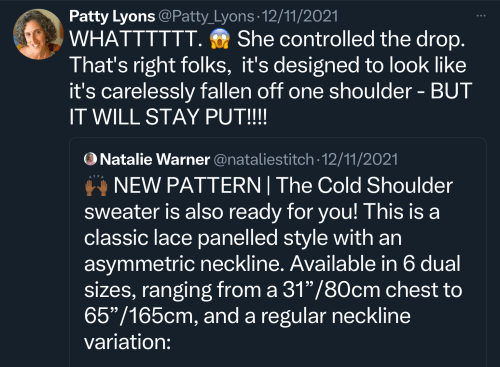
This is an off the shoulder sweater knitting pattern with a touch of glamour! The Cold Shoulder sweater features a reversible asymmetric neckline and flattering panels of knitted lace. An eyelet detail grows up into the body from the ribbed welt, and these details are echoed on the set-in sleeves.
This knitting project bobs along nicely on 5mm (US8) needles. A regular sweater variation is included if you’d prefer to keep both shoulders warm.
Either way, having two patterns in one can only be a good thing! The Cold Shoulder sweater promises to be a lightweight lace layer that will see you through most of the year.
Sizing and finishing tips for this off the shoulder sweater pattern
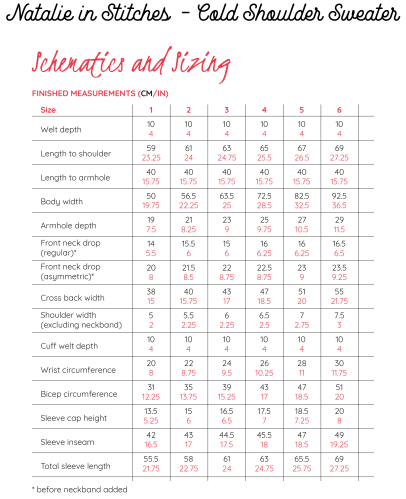
The Cold Shoulder off the shoulder sweater knitting pattern is offered in 6 dual sizes due to the elastic ribbed fabric. Please look at the spec drawing and measurement table for further details. Fitting guidance and customisation notes are included to help you get the best fit on this lace ribbed sweater pattern.
For extra drape, you can wet block the knitted pieces with the lace panels slightly stretched, so that the knit and purl columns are of equal width. Just make sure you do this before knitting the neckband so that your lovely sweater stays put – whether off the shoulder or on both shoulders 😉
Special Techniques for the Cold Shoulder sweater knitting pattern
- Lace increases and decreases (yarn over, ssk, sssk, k2tog, k3tog, CDD (central double decrease)).
The photographed sample was knitted in Debbie Bliss Rialto Lace and The Little Knitting Company Camelot Superfine Kid Mohair. These two yarns were held together throughout, knitted from separate skeins.
Substitution advice is given in the pattern notes, especially for those allergic to mohair. Visit YarnSub for more immediate buying information – but please also see the Yarn Selection tab above: https://yarnsub.com/.
Sizing, Fit, & Schematic Information
Yarn Selection, Fibre, & Fabrication
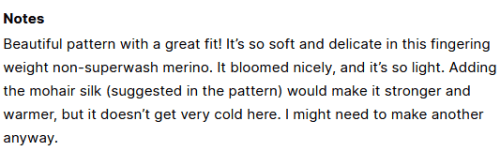
The Cold Shoulder sweater requires careful yarn selection to balance wide-neck/off-the-shoulder elasticity with lightweight, airy drape across the lacy body.
I held the yarn double in order to create a more substantial fabric. However, for a more delicate look, knit with one strand of either yarn to accentuate the lacy textures. Then again, look at the Icicle legwarmers to see how the lace texture works in a more solid, DK yarn. You might be surprised! It’s surprisingly versatile.
If you’d prefer a little more simplicity, you have my blessing to omit the lace leaf panels and convert them to stocking stitch. You’ll still have the cute eyelet panel, which travels up through the rib, as a pretty detail.
Fibre Composition & Behaviour
- Protein Fibres (Wool, Mohair, Silk): Protein-dominant yarns or mohair/silk blends are ideal for maintaining gentle spring in the neckband so it clings securely to the shoulders without slipping down.
- Cellulosic Fibres (Cotton, Linen, Tencel): If choosing plant fibres, keep in mind that low natural elasticity may cause the neckband to relax over time. If using cellulosic yarns, consider working with a slightly smaller needle size for the neck ribbing, or work the regular scoop neck variation for better support.
Yarn Weight & Meterage
Fingering to Lace (often held double) or single strand DK. Check pattern options for multi-strand styling. Match yarn requirements by total meterage.
Yarn Construction
Holding two fine strands together (such as a fingering wool held with a mohair/silk halo) creates a soft, cloudy texture while keeping the garment feather-light. For crisp, sculpted leaf panels, select a smooth, plied DK yarn. You can go even finer (one lovely knitter on Ravelry used a 4ply/fingering weight yarn held single) — just mind how you go with drape and structure!
Pattern Support
After checking out, you’ll be emailed a link to download a digital PDF file of your chosen pattern(s), plus any separate fitting guides as appropriate. These will also be PDF files. You’ll also receive further tutorials, inspiration, and general guidance via email after purchase, so please keep an eye on your inbox.
If you also choose to create an account – you can do this at checkout OR by clicking on the avatar in the top right-hand corner – your purchases will be stored in your account area for safekeeping. I also recommend downloading all files immediately and saving them to your preferred computer or device so that you have a local copy.
You then have the option of either printing out the pattern or reading it from your mobile device – whichever suits you best. And if you get stuck along the way or have any constructive feedback to share, you can email me anytime. I’m always glad to hear from my community and see their interpretations of my patterns!
New to Natalie in Stitches knitting patterns? If you’re not ready to cast on or need a little more time to decide, I’ve created a worksheet especially for getting you settled with my designs. Download it here.